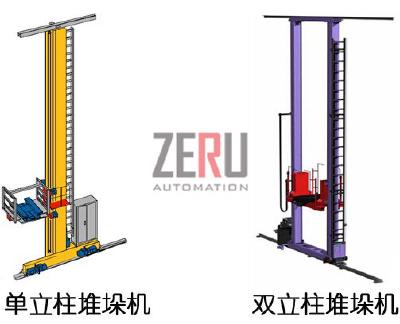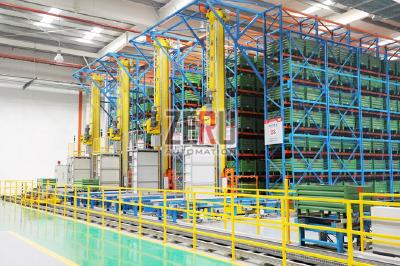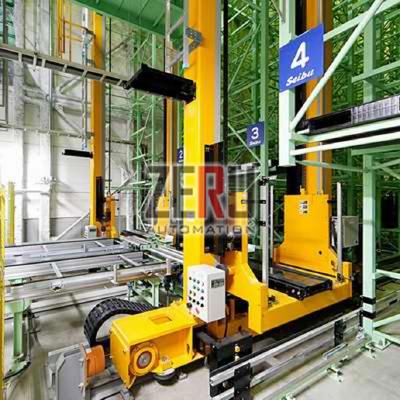
The stacker crane is the access equipment in the automated stereoscopic warehouse. It is generally divided into single-column and double-column structures. The operation requirements are completed by three drive mechanisms: traveling, lifting and forking. It adopts internationally advanced variable frequency control systems and absolute addressing systems for fully closed-loop control, cooperating with high-precision addressing methods such as barcodes or laser ranging to achieve high-precision operation of the stacker crane. According to the structure, it is divided into single-column stacker cranes and double-column stacker cranes.
Single Column Stacker Crane
Simple Structure: Composed of a single column, saving materials and thus investment, simple and practical, low failure rate, and easy maintenance.
High Speed: When running fully loaded in ultra-long and ultra-high roadways, the running and lifting speeds can reach up to 120m/min and 40m/min respectively, and the fork picking speed can reach up to 40m/min.
Simple Operation: The human-machine interface (HMI) adopts Siemens touch screen; most buttons, knobs and indicator lights are cancelled, and only the power switch and emergency stop button are retained. The operation is very simple and convenient.
High Safety: The running, lifting and fork mechanisms are equipped with multiple mechanical safety protection devices and electronic control safety protection functions, totaling up to 19 types, ensuring the safe and smooth operation of the stacker crane equipment and the safe storage and transmission of goods.
High Reliability: All electronic control components adopt internationally renowned brands, and the mean time between failures of key components reaches more than 20,000 hours.
High Intelligence: Automatically receive, analyze and execute instructions; automatically record and upload all status information and fault data; when various abnormalities occur during operation, it can instantly stop automatically and alarm.
Double Column Stacker Crane
Applied to Warehouses with Higher Customization Requirements: The rack structure is a rectangular frame composed of two columns, an upper beam and a lower beam; compared with the single column, it is more suitable for applications with large loads (>1500kg), ultra-height (>20 meters), and long and large pieces (length > 2 meters).
Flexible Carrying Method: Can be configured with multiple forks to carry two unit loads at the same time, thereby improving higher storage and shipment efficiency.