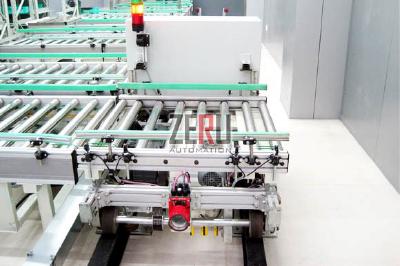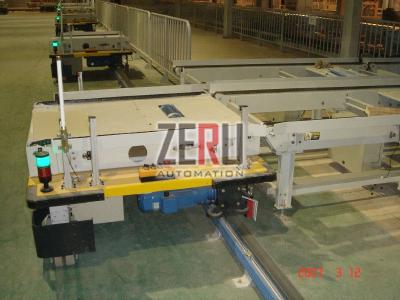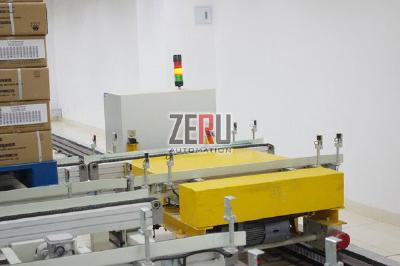
Rail Guided Vehicle (RGV), as an intelligent rail-guided handling device in automated logistics systems, can achieve high-speed and efficient flat automatic positioning of unit materials, with a high degree of automation and flexibility.
RGV has the function of dynamic transfer along a fixed path, realizing the transfer of materials between different workstations, making the equipment layout of the automated conveyor system more compact and simple, and improving the material conveying efficiency. It is increasingly widely used in automated logistics systems. According to the rail form, RGV can be divided into reciprocating straight RGVs and circular RGVs.
1. Control System
RGV has an independent control system that controls its travel, conveying operations, positioning, alarms, and communication. The control system consists of electronic control system PLC, frequency inverters, distributed IO, detection devices, HMI, etc., to achieve manual/automatic control functions in the RGV automated logistics system.
2. Control Mode
(1) Addressing Mode. When the RGV runs back and forth on the rail at high speed to the designated platform to pick up goods, precise positioning is required. RGV addressing modes generally include the following three: ① Addressing chain + incremental encoder, ② Laser ranging addressing, ③ Barcode reading addressing.
(2) Operation Mode. The RGV runs at high speed and the body is relatively small, so it cannot be operated on the RGV body itself. It is generally operated by remote control.
3. Power Supply Mode
RGVs typically use sliding contact line power supply and drag chain power supply.
4. Communication Mode
Connection with the line control PLC is generally through forming a PROFIBUS bus network or Ethernet. The PROFIBUS bus network communicates through ground infrared communicators, and Ethernet communicates through wireless Ethernet.