
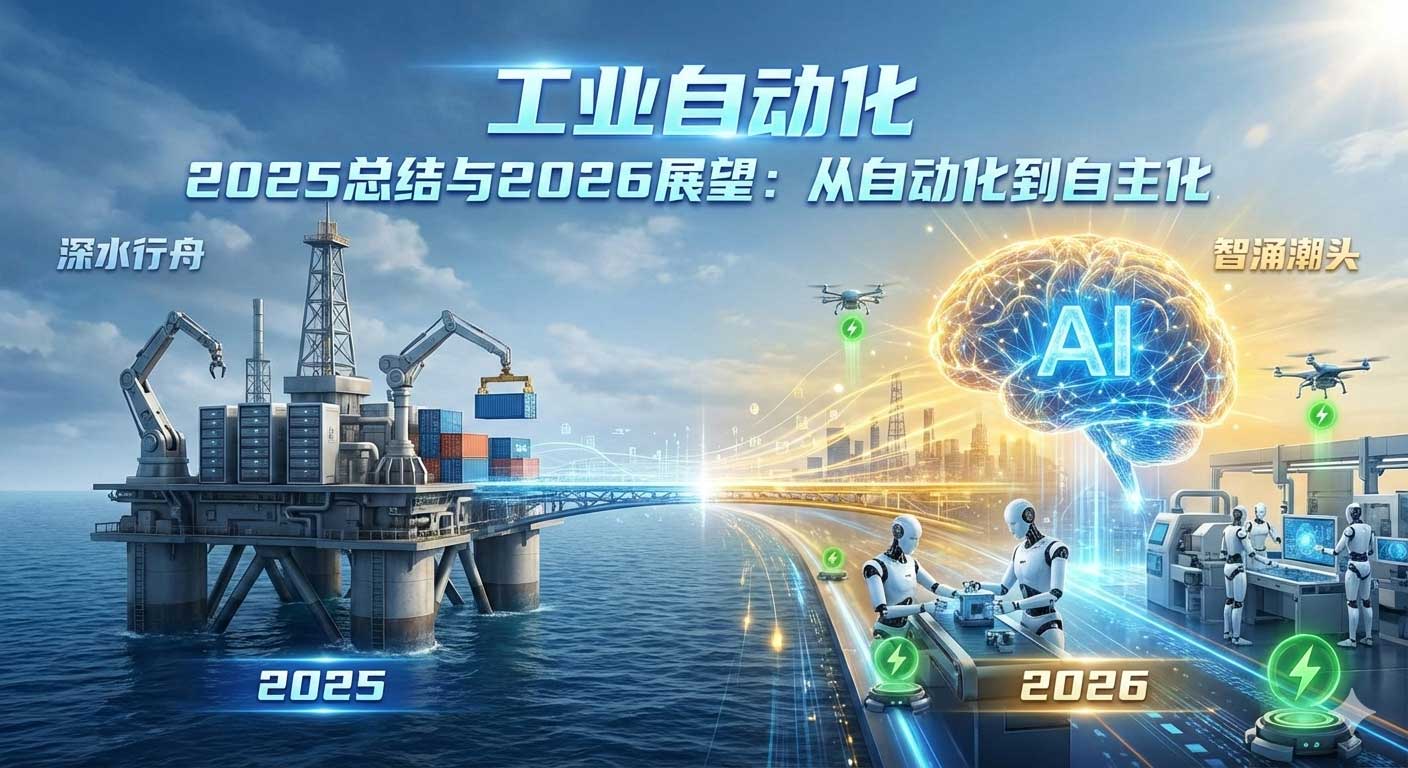
Looking back at the intersection of 2025 and 2026, the industrial automation industry has just experienced a critical year of switching from “frenzied expansion” to “rational deep cultivation”. In 2025, global manufacturing supply chain restructuring accelerated, technological singularities appeared frequently, and the industry struggled to break through the intertwining of “involution” and “going global”.
Looking ahead to 2026, we are standing on the threshold of leaping from “automation” to “autonomy”. If 2025 was the first year of AI entering the industry, then 2026 will be the year of explosion for AI reshaping the industrial ecosystem.
2025 Review: Structural Breakthrough under Stock Game
The keywords for the industrial automation market in 2025 can be summarized as differentiation and intelligence. Bidding farewell to the bonus period of general rise in the past, the industry has officially entered a knockout match centered on technological hard power and cost control capabilities.
1. Market Pattern: Fire and Ice
In 2025, constrained by fluctuations in the global macro economy, the market for general automation equipment (such as standard PLCs, servos, inverters) was weak in growth, and price wars spread from the low end to the mid-to-high end, further squeezing industry profits.
- New Energy Correction: The former growth engines—lithium battery and photovoltaic equipment—after experiencing overcapacity in the previous two years, entered a cruel period of destocking and shuffling in 2025, with equipment investment shrinking significantly.
- New Growth Poles: In contrast, high-precision components related to semiconductor packaging and testing equipment, aerospace manufacturing equipment, and the humanoid robot industry chain have become new growth highlights.
2. Technology Landing: AI Sinks from “Cloud” to “Edge”
The biggest technological breakthrough in 2025 lies in the deep integration of generative AI and edge computing.
- Actual Combat of Industrial Large Models: Industrial AI is no longer just visual algorithms for quality inspection. Industrial Copilot based on Large Language Models (LLM) began to assist engineers in writing code and debugging production lines, significantly lowering the threshold for system integration.
- Embodied Intelligence Emerges: Humanoid robots began to enter automotive final assembly workshops in small batches for field testing. Although mass production has not yet been achieved, their demonstrated flexible operation capabilities have shown the industry the dawn of replacing complex manual labor.
3. Strategic Shift: From “Product Export” to “Capacity Going Global”
Facing geopolitical uncertainties, the overseas strategy of Chinese automation companies underwent a qualitative change in 2025. Companies were no longer satisfied with simple equipment exports, but followed downstream customers (such as automobile and home appliance companies) to build overseas bases in Mexico, Southeast Asia, Hungary, and other places, realizing the model upgrade of “global manufacturing, local service”.
2026 Outlook: Moving towards a New Era of “Autonomous Manufacturing”
If 2025 was a period of adjustment, then 2026 will be a year of “qualitative change” for the industrial automation industry. Industry competition will upgrade from a single hardware competition to an ecological battle of “soft and hard combination”.
1. Trend 1: Evolving from “Automation” to “Autonomy”
In 2026, the industrial site will not only be “automatically executing” instructions, but will also have the ability to “make autonomous decisions”.
- AI Agent Entry: Combined with multimodal large models, equipment will have adaptive capabilities. For example, when there are slight fluctuations in production line raw materials, the machine will no longer report an error and stop, but will automatically adjust process parameters to ensure yield.
- Thorough Opening of IT and OT: With the popularity of 5G-A (5.5G) and TSN (Time Sensitive Networking), data islands will be broken, real-time control and data analysis will achieve millisecond-level synchronization, and true “dark factories” will spread from leading companies to腰部 companies.
2. Trend 2: Servitization Transformation and Business Model Reconstruction
The meager profit of hardware will force equipment manufacturers to look for new profit pools. In 2026, RaaS (Robot as a Service) and EaaS (Equipment as a Service) models will become more popular.
- Customers no longer need to invest huge amounts of money to purchase equipment at one time, but pay according to output or usage time. This requires equipment manufacturers to have strong remote operation and maintenance and predictive maintenance capabilities, and the proportion of software and service revenue will increase significantly.
3. Trend 3: Green Intelligent Manufacturing Becomes a Hard Indicator
With the deepening of regulations such as the EU “Carbon Border Adjustment Mechanism”, automation equipment in 2026 must have “carbon attributes”.
- Equipment must not only be efficient, but also have real-time energy consumption monitoring and carbon footprint tracking functions. Energy-saving motors and energy feedback inverters will become standard, and green manufacturing capabilities will become the admission ticket for equipment manufacturers to enter the high-end supply chain.
4. Trend 4: Industry Consolidation Accelerates, Matthew Effect Intensifies
Under the double squeeze of rising technical thresholds (AI computing power demand) and increasing financial pressure, 2026 will usher in a wave of mergers and acquisitions. Small and medium-sized system integrators lacking core algorithm capabilities will face elimination or acquisition, and industry resources will further concentrate on platform giants with full-stack technology (control + drive + sensing + AI).
Conclusion
In 2025, we witnessed the squeezing of bubbles and the consolidation of cornerstones; in 2026, we will welcome a new era of intelligent emergence.
For automation practitioners, future equipment will no longer be cold steel, but intelligent partners with perception and thinking capabilities. In the new cycle, only those companies that dare to embrace AI, deeply cultivate craftsmanship, and have a global vision can cross the cycle and stand at the forefront of the tide.